Single Quadrupole GC-MS for the Determination of Ethyl Carbamate in Food - Anyipu 7700
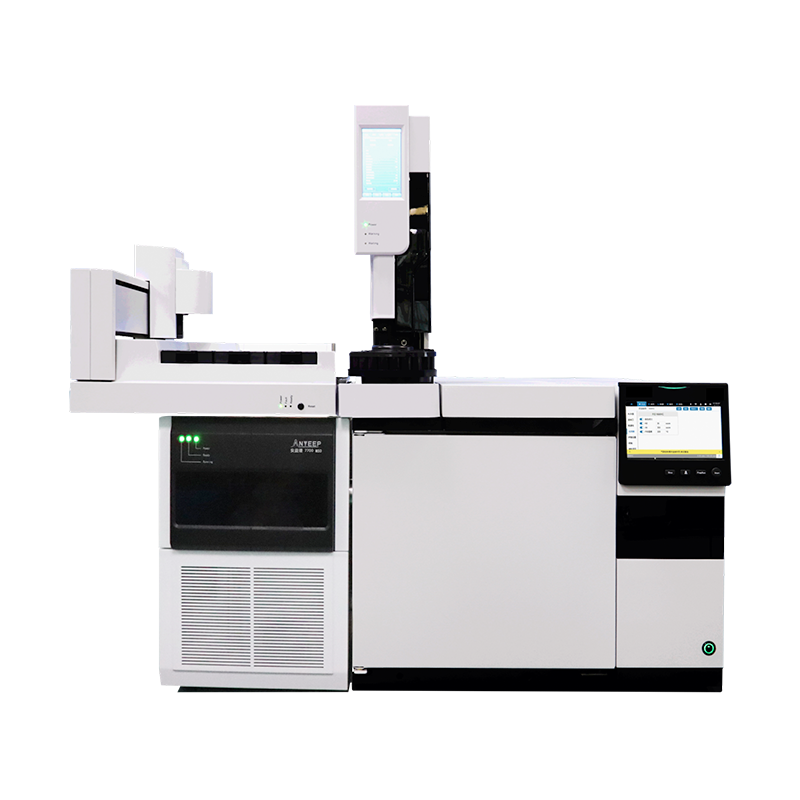
Referencing GB 5009.223-2014 National Food Safety Standard: Determination of Ethyl Carbamate in Foods, use a gas chromatography-mass spectrometry (GC-MS) system to analyze ethyl carbamate and its internal standard D5-ethyl carbamate mixture. Perform qualitative analysis of the ethyl carbamate standard using Scan mode based on retention time, mass spectra, and characteristic ion pairs. Quantify using Sim mode with D5-ethyl carbamate as the internal standard via the internal standard method.
Experimental Conditions
Chromatographic Parameters
Injection mode: Splitless; Purge time: 0.8min; Purge flow: 50mL/min.
Liner: Glass wool-free; Injection volume: 1.0μL; Inlet temperature: 220℃;
Column: DM-Wax 60m × 0.25mm × 0.25µm
Column flow rate: 1mL/min (constant flow);
Column oven temperature program: 50°C (1 min), 8°C/min, 180°C (3 min), 10°C/min, 240°C
Mass Spectrometry Parameters
Ion Source: 240°C; Transfer Line: 250°C; Ionization Energy: 7 eV; Filament Current: 100 µA; EM Voltage:
900V; solvent delay 15min
Scan Mode: Full Scan (SCAN) and Selected Ion Monitoring (SIM); SCAN Mode
Experimental Results
Analyze according to the instrument conditions, from low to high concentration. The ethyl carbamate concentration points are 10.0ng/mL, 25.0 ng/mL, 50.0 ng/mL, 100 ng/mL, 200 ng/mL, 400 ng/mL, and 1000 ng/mL (containing 200 ng/mL D5-ethyl carbamate internal standard); 2.0 ng/mL, 5.0 ng/mL, 10.0 ng/mL, 15.0 ng/mL, and 40.0ng/mL (containing 200 ng/mL D5-ethyl carbamate internal standard). Plot the ratio of analyte to internal standard response on the x-axis and the ratio of analyte to internal standard concentration on the y-axis. Construct calibration curves using least-squares fitting. The squared correlation coefficients (r²) for the two curves are 0.9999 and 0.9987.
Repeat injections of 10ng/mL, 400ng/mL, and 1000ng/mL (internal standard D5-ethyl carbamate concentration: 200ng/mL) for 6 runs. Compare retention times and peak areas. The relative standard deviations (RSD) of the peak areas are 3.2%, 0.5%, and 0.5%, respectively.
Prepare urethane standard solutions at concentrations of 2.0ng/mL and 5.0ng/mL. Using signal-to-noise ratios (S/N) of 3 and 10 as the limits of detection and quantification, respectively, the limit of detection for urethane is approximately 2.0ng/mL, and the limit of quantification is approximately 5.0ng/mL. The instrument meets the requirements for determining urethane in food.
This study establishes a method for determining ethyl carbamate in food using gas chromatography-mass spectrometry. The method demonstrates excellent linearity, low detection limits, and good repeatability, making it suitable for ethyl carbamate analysis in food samples.