Determination of 6 sweeteners in fruit juice using the Anyeep TQ9120 ultra-high-performance liquid chromatography-tandem mass spectrometry system
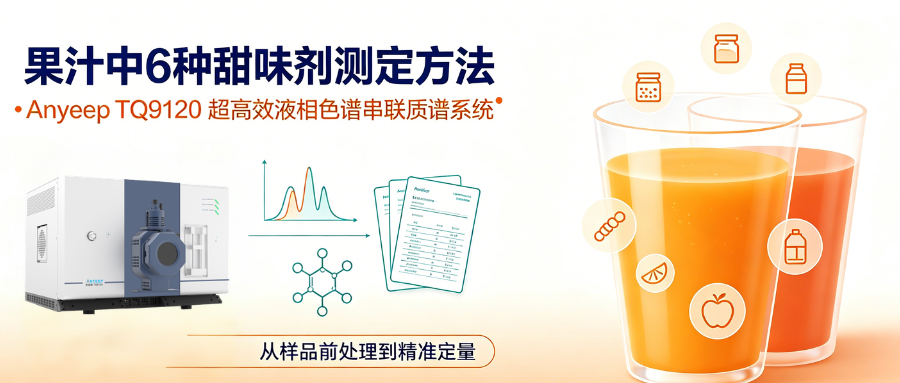
This study utilized the Anyeep TQ9120 ultra-high-performance liquid chromatography-tandem mass spectrometry system from Anyi Pu Company to establish a method for the simultaneous detection of 6 sweeteners in fruit juices. The method demonstrated excellent linearity, and its limits of detection and quantification meet relevant regulatory standards. Using this method and equipment enables the identification and quantification of sweeteners.
Synthetic sweeteners are artificially produced food additives with pronounced sweetness. Leveraging high sweetness intensity, low calories, cost-effectiveness, and excellent stability, they are widely used in food processing. As a core ingredient for sugar-reduced product development, synthetic sweeteners effectively replace traditional sucrose to meet consumer demand for sugar control and weight management.
Sample types containing synthetic sweeteners in food are diverse, covering beverages, dairy products, baked goods, and confectionery. Specific examples include fruit juices, carbonated drinks, flavored fermented milk, breads and pastries, candied fruits, and frozen desserts. Due to matrix differences, the regulations for adding synthetic sweeteners and their detection methods vary across sample types. China enforces strict standards for synthetic sweetener use, primarily guided by the National Food Safety Standard for Uses of Food Additives (GB 2760-2024). This standard clearly defines the scope of use, maximum usage levels, and requirements for combined use of common synthetic sweeteners such as acesulfame potassium and aspartame, while also establishing specific standards for individual sweeteners. Developed through rigorous risk assessments, these standards ensure the rational application of synthetic sweeteners, safeguard food safety for consumers, and promote the healthy development of the low-sugar food industry. This method is based on SN/T3538-2013 and employs external standard calibration for quantification.
Instruments and Reagents
AnyeepTQ9120 Ultra-High-Performance Liquid Chromatography-Tandem Mass Spectrometry System
Acetonitrile (MS grade, Thermo Fisher, USA)
Formic acid (mass spectrometry grade, CNW Technologies, Germany)
Ammonium formate (MS grade, CNW Technologies, Germany)
Liquid Chromatography Conditions
Mobile Phase A: 0.1% formic acid in water, containing 5 mM ammonium formate
Mobile Phase B: Acetonitrile
Column: Waters ACQUITY UPLC BEH C18 1.7μm, 2.1*100mm
Column Temperature: 35 ℃
Flow rate: 0.3 mL/min
Injection Volume: 10 μL
Mass Spectrometry Conditions
Ionization Source: Electrospray Ionization (ESI-)
Source Temperature: 550°C
Spray voltage: 4500V
Air Curtain Air: 40 psi
Mist: 60 psi
Auxiliary Air: 80 psi
Crash Air: 10
Scan Mode: DMRM
Sample Processing
Sample ProcessingTake an appropriate amount of sample, degas by ultrasonication for 20 min. Weigh 2 g (accurate to 0.01 g) of the sample into a 100 mL volumetric flask, dilute with water to volume, filter through a 0.45 μm membrane, and analyze using liquid chromatography-tandem mass spectrometry.
Standard Curve PreparationAccurately pipette an appropriate amount of the standard intermediate solution and prepare a mixed standard solution with sweetener concentrations of 1 μg/L, 2 μg/L, 5 μg/L, 10 μg/L, 20 μg/L, 40 μg/L, 50 μg/L, 100 μg/L, 200 μg/L, and 500 μg/L using blank matrix.
Summary
This study established an ultra-high-performance liquid chromatography-tandem mass spectrometry (UHPLC-MS/MS) method using the Anyeep TQ9120 system for the analysis of 6 sweeteners. The results demonstrate that the method offers excellent sensitivity, stability, and linear range, making it suitable for routine sweetener analysis.