7700 Headspace-GC-MS Determination of Ethylene Oxide in Masks
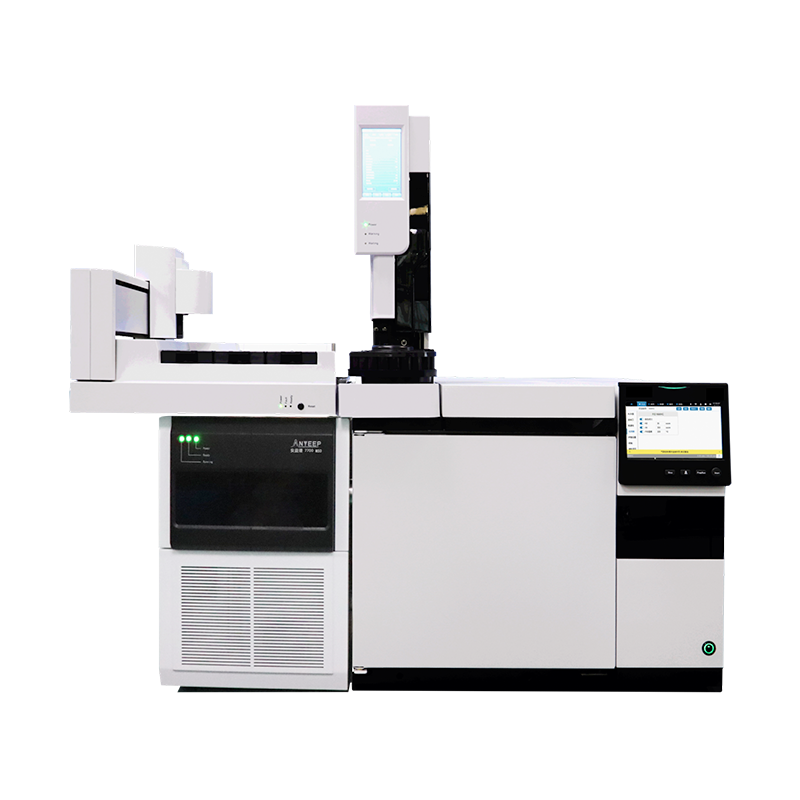
The technical requirements for GB 19083-2010 Medical Protective Masks, YY0469-2011 Surgical Masks, and YY/T 0969-2013 Disposable Medical Masks stipulate that the residual ethylene oxide (EO) content in masks sterilized with EO must not exceed 10 µg/g. This study determined EO levels in masks using headspace gas chromatography-mass spectrometry (HS-GC-MS). The instrument was operated in Scan mode to identify EO based on mass spectra and characteristic ions. Qualitative analysis was performed using Sim mode by comparing retention times and characteristic ion ratios against standards. Quantification was achieved via the external standard method.
Experimental Conditions
Headspace conditions
Oven temperature: 60°C; Loop temperature: 90°C; Transfer line temperature: 100°C; GC cycle time: 30 min; Sample vial
Equilibration time: 30 min; Pressure equilibration time: 1 min; Injection time: 1 min; Fill pressure: 15 Psi; Loop maximum
Final pressure 10.05Psi; Loop equilibration time: 0.05min
gas phase conditions
Injector temperature: 200°C; Injector mode: split; Split ratio: 10:1
Column: DB-624 60m × 0.25mm × 1.4µm; Constant flow mode; Column flow rate: 1mL/min
Column oven temperature program: 40°C (1 min) → 15°C/min → 130°C (1 min)
Mass Spectrometry Conditions
Ion source: 240°C; Transfer line: 200°C; Solvent delay: 5.2min;
Scan modes: Full Scan (SCAN) and Selected Ion Monitoring (SIM);
Experimental Results
Ethylene oxide calibration curve (dissolved in 5 mL ultrapure water: 1 µg, 5 µg, 10 µg, 15 µg, 20 µg)
Standard stock solution: concentration 50000mg/L(, solvent methanol.
Standard intermediate solution: Pipette 980 µL of methanol precisely into an injection vial, then add 20 µL of standard stock solution precisely. Mix well to obtain a solution with concentration 1000mg/L.
Standard Working Solution: Precisely transfer 5.0 mL of pure water into 5 20 mL headspace vials and seal them. Using a microsyringe, inject 1 µL, 5 µL, 10 µL, 15 µL, and 20 µL sequentially through the septum to prepare a series of 5 concentration points.
Plot the peak area of the quantitation ion for ethylene oxide on the x-axis and the ethylene oxide content (µg) on the y-axis; r² is the square of the linear correlation coefficient.2 Good linear relationship for 0.9998.
Parallel sampling of 6 injections (10µg/5mL), 1 injections each). Retention times and peak areas were compared. The relative standard deviation (RSD) for retention time was 0.01% and for peak area was 1.78%, indicating good precision.
Perform selected ion scanning on reference solutions containing 0.2 µg (in 5 mL pure water) and 0.5 µg (in 5 mL pure water) of ethylene oxide. Use signal-to-noise ratios of 3 and 10 as the limit of detection (LOD) and limit of quantification (LOQ), respectively. For a sample mass of 1 g dissolved in 5 mL pure water, the LOD must be ≤ 0.2 µg/g and the LOQ must be ≤ 0.5 µg/g.
Weigh a cut-up mask sample for a spike recovery test. The average spike recovery rate is 97.3%.
This study establishes a headspace gas chromatography-mass spectrometry (HS-GC-MS) method for determining ethylene oxide in masks. The method demonstrates excellent linearity, precision, and accuracy, along with a low limit of detection, making it a reliable approach for ethylene oxide analysis.