AnYipu Single Quadrupole Gas Chromatograph-Mass Spectrometer for Determination of Volatile Organic Compounds in Water

As living standards improve, public concern over environmental safety, food quality, and pharmaceutical security grows. Volatile organic compounds (VOCs) in water are a standard testing parameter. Following national standards, we established a method for measuring VOCs in water using headspace gas chromatography-mass spectrometry (GC-MS).
Experimental Conditions
Headspace conditions
Equilibrium temperature: 65°C; Equilibrium time: 40 min; Loop temperature: 80°C (Scan method set to 110°C);
Transfer line temperature: 105°C (Scan method set to 120°C); Injection volume: 1.0 mL; Cycle time: 45 min;
Pressure equalization time: 1 min; injection time: 0.8 min; fill pressure: 15 psi; fill flow rate: 50 mL/min.
gas phase conditions
Injection mode: Split; Split ratio: 5:1; Injection port: 250°C; Carrier gas: Helium
Column: DB-624 60m × 0.25mm × 1.4µm, Constant Flow Mode. Column Flow Rate: 1mL/min
Column oven temperature program: 40°C (2 min) → 5°C/min to 120°C (3 min) → 10°C/min to 30°C (5 min)
Mass Spectrometry Conditions
Ion source: 240°C; transfer line: 250°C; solvent delay: 5 min;
Scan Modes: Full Scan (SCAN) and Selected Ion Monitoring (SIM)
SCAN mode scan range: 35~30 amu
Experimental Results
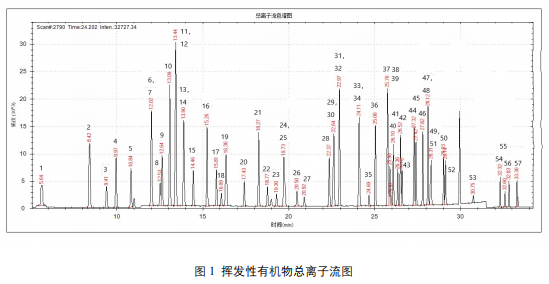
Volatile organic compound (VOC) standards were tested under the aforementioned conditions to generate total ion chromatograms for each compound, as shown in Figure 1.
Prepare standards at concentrations of 2 ng/mL, 4 ng/mL, 10 ng/mL, 20 ng/mL, and 40 ng/mL according to the procedure above.
Condition for online testing: linear correlation coefficient R² ≥ 0.99.
Prepare standards with concentrations of 10ng/mL, 40 ng/mL, 100 ng/mL, 200 ng/mL, and 400 ng/mL as described above.
Instrument test conditions: On-machine detection, linear correlation coefficient R² ≥ 0.99 for all compounds.
This study established a method for detecting volatile organic compounds in water using headspace gas chromatography-mass spectrometry (HS-GC-MS), with linear calibration curves.
Good correlation, with linear correlation coefficients (r²) all greater than 0.995. Repeatability, method detection limits, and recovery rates are all excellent, fully meeting requirements.
Relevant standard requirements.