GMA6500/6500K: Why is the cavity designed for 200°C?
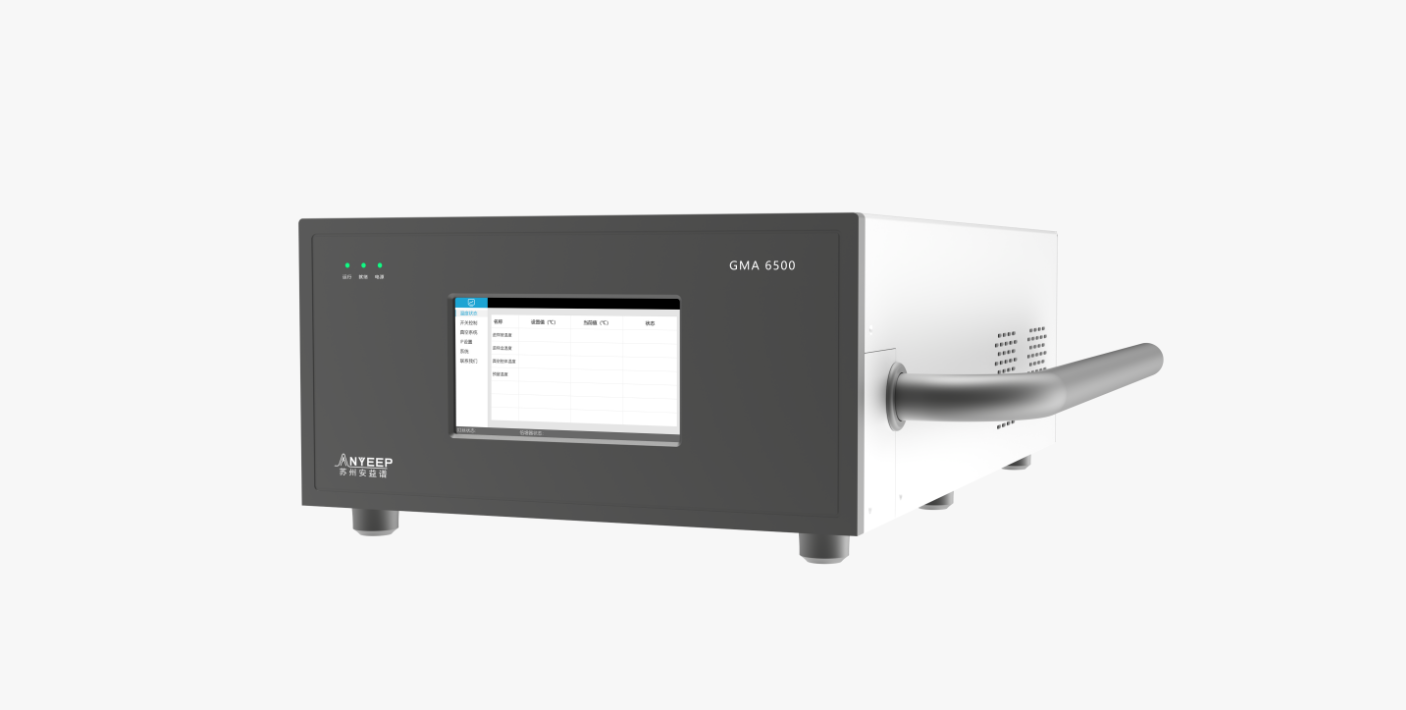
The challenge in online small-molecule detection isn't whether a signal can be detected, but whether that signal accurately reflects the true sample composition at the moment of sampling. This article examines two sources of bias—wall adsorption and foreline pump oil contamination—to explain how GMA6500/6500K achieves a full-metal stainless steel chamber at 200°C, constructs its vacuum chain using an oil-free foreline and turbomolecular pump, and demonstrates why vacuum observability is critical for continuous operation and troubleshooting.
The challenge in online small-molecule detection isn't whether you can detect anything. Once the instrument is running, peaks will always appear on the spectrum. The real difficulty lies elsewhere: Does the signal read right now still reflect the actual composition at the sampling point?
The deviation has two sources. First, wall adsorption: gas molecules linger on the inner walls and slowly release, causing tailing. Second, oil contamination from the backing pump: hydrocarbon fragments mix into the background, blurring low-mass detection. Neither can be corrected by the algorithm. This is where Suzhou Anyipu's GMA6500 and GMA6500K gas analysis modules are designed to address the issue.
Temperature is a precision parameter.
The GMA6500 series features a full-metal stainless steel mass spectrometer chamber with a maximum temperature of 200°C. Temperature is specified in the table because adsorption is a temperature-dependent equilibrium process. Water, ammonia, and small organic molecules have long residence times on stainless steel surfaces at room temperature. After switching samples, residual components from the previous batch continue to desorb, causing memory effects.
After the chamber heats up, adsorption sites on the wall are continuously occupied and released, causing residual signals to decay faster. For online monitoring, this means readings return to baseline more quickly after switching between gas lines or changing process states, resulting in tighter correlation with actual field events. The all-metal construction also offers another advantage: fewer outgassing soft materials mean a cleaner background, allowing low-concentration signals to be detected.
The vacuum chain sets the lower bound of this base.
Vacuum isn't a single metric—it's a chain. The GMA6500 series uses an oil-free diaphragm pump as the foreline and a high-performance turbomolecular pump to achieve high vacuum.
Selecting an oil-free foreline pump addresses the issue of oil. Oil-sealed pumps generate oil vapor backflow during operation, allowing hydrocarbons into the chamber and creating a broad background peak in the mass-to-charge ratio range of 40 to 100. This is precisely the region critical for small molecule analysis; high background levels compromise measurement accuracy. Diaphragm pumps use mechanical action to evacuate gas, eliminating oil from the chamber and removing the contamination source at its origin. Turbomolecular pumps then reduce pressure to the level required for mass spectrometry operation. Their pumping speed and compression ratio determine both the sample residence time within the chamber and the duration needed to pump down from atmospheric pressure to operating vacuum.
Vacuum state must be visible
The GMA6500 series features a full-range vacuum gauge to monitor the instrument's vacuum status in real time.
The value of this configuration becomes fully apparent during troubleshooting. When the online mass spectrometer runs continuously, vacuum degradation is often the earliest sign of an issue: aging seals, micro-leaks in the sample inlet line, or declining pump performance all manifest first as pressure anomalies before showing up as elevated background or sensitivity drift. Without vacuum readings, users see "incorrect data" but cannot pinpoint whether the problem lies with the sample, the inlet system, or the instrument itself.
Online and In-situ: Two Access Methods
The GMA6500 and GMA6500K are designed for online and in-situ mass spectrometry analysis of small molecules, requiring no complex sample preparation. In the semiconductor industry, these modules enable high-purity gas analysis and process gas monitoring to detect trace impurities exceeding limits. For environmental monitoring and industrial process control, they support continuous trend tracking rather than single-point sampling.
The difference between the two access methods lies in the sampling path. In-situ means placing the probe close to the reaction or process site, resulting in a short path and minimal lag. Online involves extracting samples from the main pipeline, requiring consideration of pipe material, length, and insulation. Both methods share the same chamber requirements: low adsorption, low background, and controllable vacuum.
Conclusion
The reliability of an online mass spectrometer is built on chamber material, maximum temperature, vacuum chain integrity, and pressure observability. Individually, these parameters are straightforward; together, they determine whether the device maintains accuracy during continuous operation. Ensuring that readings match real-time conditions is the core design principle behind GMA6500 and RGA6500K.