Determination of Organochlorine Pesticides by Anypu GC-MS/MS

Based on the standard "GB 23200.113-2018 National Food Safety Standard: Determination of 208 Pesticide Residues and Their Metabolites in Plant-Derived Foods by Gas Chromatography-Mass Spectrometry", we established a method using triple quadrupole GC-MS to determine 22 organochlorine pesticides. Qualitative analysis was performed via full scan mode based on retention time, mass spectra, and characteristic ions for each pesticide standard. Parent-daughter ion pairs were identified using precursor ion scanning. For multiple ion pairs, optimal collision voltages (5V to 35V) were determined using MRM mode with varying collision energies. Quantification was carried out using the external standard method in MRM mode. We evaluated the linearity between organochlorine pesticide concentrations and peak areas, which showed excellent correlation. Repeatability tests across multiple concentration levels yielded low relative standard deviations, indicating good instrument stability.
Experimental Conditions
Chromatographic Parameters
Injection volume: 1µL; Injection mode: splitless; Purge flow rate: 50 mL/min; Purge time: 1 min; Carrier gas saving flow
Quantity: 20mL/min; Carrier gas saving time: 2 min; Column flow rate: 1mL/min; Carrier gas: He; Collision gas: Ar,
22 Psi; Inlet Temperature: 280°C
Column: DB-5MS 30m × 0.25mm × 0.25µm, Constant Flow Mode
Column oven temperature program: 50°C (1 min) 40°C/min 120°C (0 min) 20°C/min 200°C (1 min) 5°C/min
250°C (2 min) 20°C/min 280°C (2 min)
Mass Spectrometry Parameters
Ion source temperature: 250°C; transfer line temperature: 250°C; solvent delay: 5 min;
Scan modes: Full scan (SCAN), product ion, and multiple reaction monitoring (MRM)
Experimental Results
Prepare standard solutions at concentrations of 50, 100, 150, 200, 300, 400, and 500 ng/mL using n-hexane as the solvent. Linear correlation coefficients (r²) were all ≥ 0.99, demonstrating excellent linearity under multiple reaction monitoring (MRM) mode.
Prepare a sample with a concentration of 100 ng/mL and perform parallel measurements 6 times, comparing retention time and peak area. The relative standard deviation (RSD) of the peak area from 6 parallel measurements is 2.2%~9.4%, and the RSD of the retention time is 0.03%~0.05%. Both peak area and retention time show minimal deviation, indicating excellent instrument repeatability.
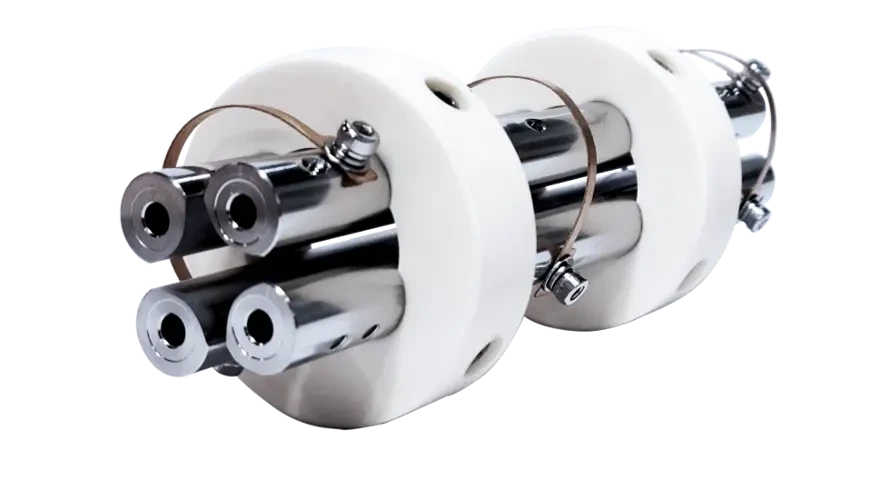
The instrument is equipped with a conjugated hyperbolic quadrupole mass analyzer.Provides a more stable ion transport channel.