TQ9120 Triple Quadrupole Mass Spectrometer: Where Does the Sensitivity Boost Come From?
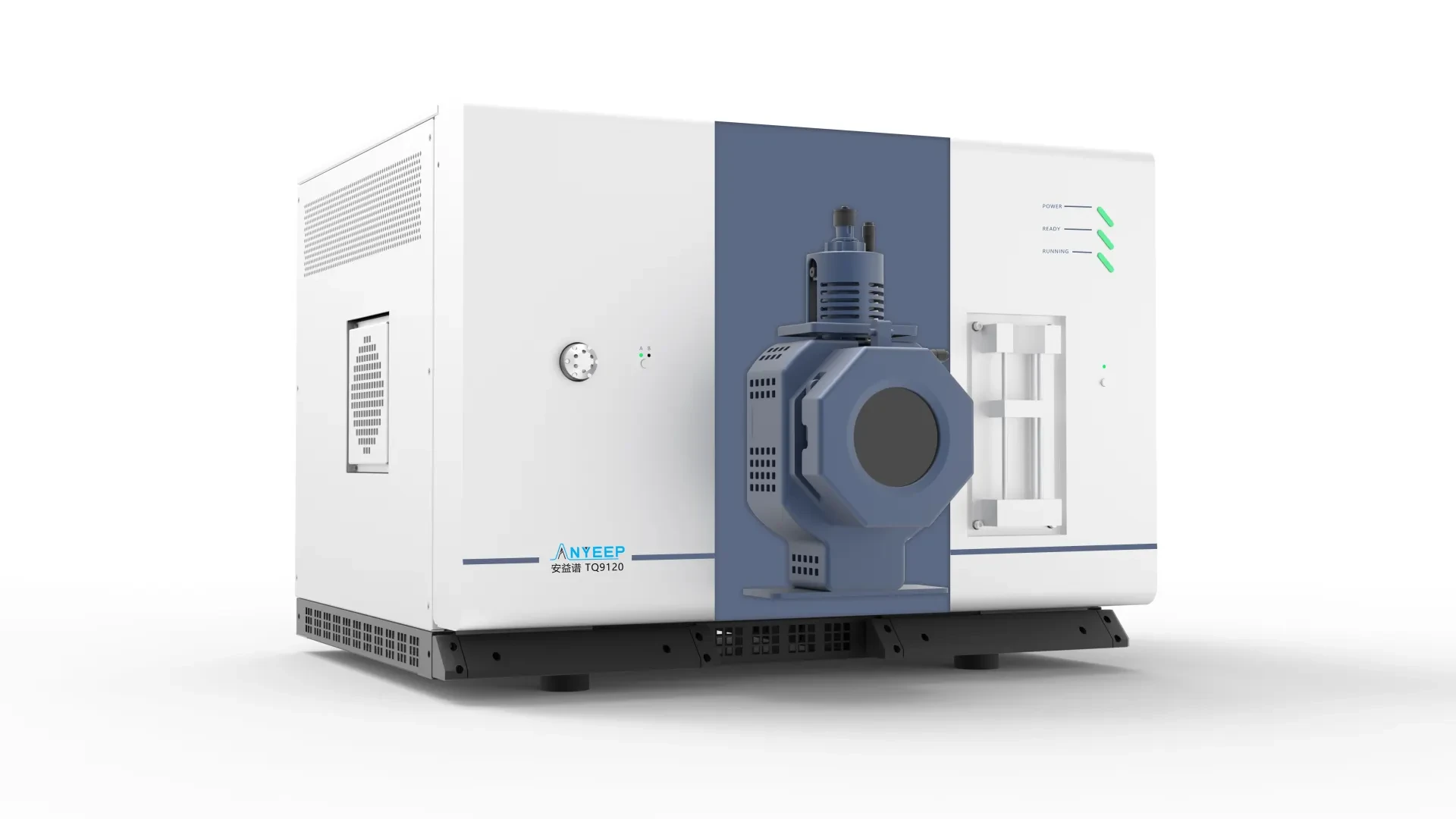
LC-MS/MS sensitivity, stability, and dynamic range are interdependent. This document outlines the improvements made to the TQ9120 across the three key stages of ion generation, transmission, and detection—including desolvation heating and flow field design, MIF ion transmission structure upgrades, curved collision cell with high-gain detection—as well as software capabilities such as Schedule MRM, auto-tuning, GLP audit trails, and typical application boundaries.
Quantitative performance in LC-MS/MS has long been constrained by a set of mutually limiting metrics: sufficient sensitivity, stability for prolonged continuous injection, and a dynamic range capable of covering samples with coexisting high and low concentrations. Compromising on any one of these causes method failure at some stage. In 2025, Suzhou Anyipu launched the TQ9120, an iteration over the previous-generation TQ9100 that directly addresses these trade-offs. The improvements focus on three key stages: ion generation, ion transmission, and ion detection.
Ionization: Convert the sample into ions more completely.
The ion source is the starting point of the entire workflow and the first component to determine sensitivity. The TQ9120 features a redesigned desolvation heater and flow structure, enabling more complete desolvation and ionization of nebulized droplets before they enter the mass spectrometer. This simultaneously improves ionization efficiency and signal stability. The ion source supports rapid switching between ESI and APCI with automatic identification, allowing method developers to validate both polar and weakly polar compounds without changing hardware. In screening scenarios covering multiple analyte classes within a single method, this capability reduces the time spent on switching and re-equilibration—factors that often dictate daily sample throughput.
Ion Transport: Recover the losses along the way
Ions entering the vacuum region from the atmospheric pressure interface experience significant losses along the path. The TQ9120 upgrades the MIF ion transmission structure, delivering a manufacturer-stated efficiency improvement of 10x. The vacuum interface features a heated backflush design that increases ion sample introduction while suppressing neutral molecules and matrix particulates from entering downstream stages. This enhanced transmission efficiency directly benefits trace analysis: for the same sample introduction, higher signal responses are achieved, providing room to further lower method detection limits. For samples with complex matrices, the interface's resistance to contamination also impacts cleaning frequency and long-term stability.
Ion Detection: Dynamic Range Determines How Far You Can Go
The mass analyzer is a high-precision triple quadrupole. The collision reaction cell features a curved design, combined with axial linear acceleration and array-based collision gas control. The curved geometry deflects neutral particles and photons from the ion path, reducing background noise. Collision gas control governs the reproducibility of fragment ion intensities, ensuring consistency across different batches using the same method. The detector employs a high-gain design with a dynamic range sufficient to simultaneously detect trace components and high-concentration samples, minimizing repeated dilutions caused by exceeding the upper limit. Since target analyte concentrations in real-world samples often span several orders of magnitude, this capability directly determines whether a single method can cover an entire sample batch.
Software & Compliance: Codify Expertise into Processes
Beyond hardware, the TQ9120 adds several software capabilities for daily operations. Schedule MRM segments acquisition by retention time windows, concentrating dwell times during target analyte peaks to ensure more stable data quality per unit time. Automatic tuning reduces the frequency of manual parameter adjustments, while automated GB pesticide residue limit evaluation replaces manual table lookups with software-based decision-making. The new GLP audit trail caters to regulated industries by recording method changes and user actions, providing traceable evidence for laboratory audits.
Application Scope and Selection Criteria
According to publicly available technical documentation, TQ9120 offers a validated method for determining 17 per- and polyfluoroalkyl substances (PFAS) in drinking water, as well as a detection protocol for alkylphenols and bisphenol A in water quality. The method provides complete data on calibration curves, limits of detection, and spiked recovery rates. Its application scope also covers food safety pesticide screening, targeted quantitative proteomics, and clinical research.