Determination of Acrylamide in Toothpaste Using the Anyeep TQ9120 Ultra-High-Performance Liquid Chromatography-Tandem Mass Spectrometry System
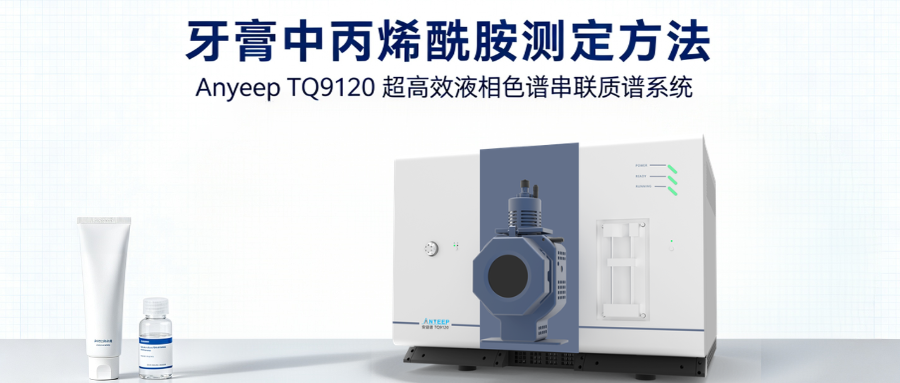
This study employed Anyeep TQ9120, an ultra-high-performance liquid chromatography-tandem mass spectrometry system from Anyeep, to develop a method for detecting acrylamide in toothpaste matrices. The method demonstrated excellent linearity and met the required detection and quantification limits per relevant standards. Using this method and equipment enables both the detection and quantification of acrylamide.
Acrylamide is a key monomer used in the synthesis of polyacrylamide. The International Agency for Research on Cancer (IARC) classifies it as Group 2A, meaning it is probably carcinogenic to humans. It can be absorbed through the digestive tract, respiratory system, and skin or mucous membranes, posing potential risks to the nervous and reproductive systems. In toothpaste manufacturing, polyacrylamide is commonly used as a binder due to its excellent thickening, binding, and stabilizing properties, which help achieve the desired viscosity and paste structure. However, due to limitations in production processes, residual unreacted acrylamide monomers inevitably remain in the final product. Given its well-established toxicological risks and the confirmed possibility of its presence in toothpaste, China has issued GB/T 44364-2024 "Determination of Acrylamide in Toothpaste — Liquid Chromatography-Tandem Mass Spectrometry" to provide a unified and authoritative technical basis for market regulation. This method is based on GB/T 44364-2024 and employs the internal standard quantification approach.
Instruments and Reagents
AnyeepTQ9120 Ultra-High-Performance Liquid Chromatography-Tandem Mass Spectrometry System
Methanol (mass spectrometry grade, Thermo Fisher Scientific, USA)
n-Hexane (mass spectrometry grade, Thermo Fisher Scientific, USA)
Formic acid (mass spectrometry grade, CNW Technologies, Germany)
Performance matches imported models
Liquid Chromatography Conditions
Mobile Phase A: 0.1% Formic Acid in Water
Mobile Phase B: Methanol
Column: ACQUITY UPLC® BEH C18 1.7 μm, 2.1×100 mm
Column Temperature: 25 °C
Flow Rate: 0.2 mL/min
Injection volume: 10μL
Mass Spectrometry Conditions
Ionization Source: Electrospray Ionization (ESI+)
Source Temperature: 150°C
Spray voltage: 5000V
Air Curtain Air: 35 psi
Mist pressure: 60 psi
Auxiliary air: 70 psi
Collision Risk: 10
Scan Mode: MRM
Sample Processing
Sample Preparation: Weigh 1 g of toothpaste sample (accurate to 0.001g) and transfer it into a 5 mL screw-cap centrifuge tube. Accurately add 10mg/L13C3- mL of acrylamide internal standard working solution 0.1. Mix thoroughly by vortexing. Accurately add 1 mL of water, cap the tube, and mix by vortexing followed by sonication for 5 min. Then add 5 mL of n-hexane, vortex for 1 min, and centrifuge at 4000r/min for 5 min. Collect the lower aqueous layer, filter through a 0.22 μm microporous membrane, and proceed with analysis.
Standard Curve Preparation: Accurately pipette an appropriate volume of standard intermediate solution (10 mg/L) and dilute with water to prepare a mixed standard solution with acrylamide concentrations of 1 μg/L, 2 μg/L, 5 μg/L, 10 μg/L, 20 μg/L, 50 μg/L, 100 μg/L, 200 μg/L, 500 μg/L, and 1000 μg/L. The concentration of the ¹³C₃-acrylamide internal standard is 100 μg/L.
Summary
This study establishes an ultra-high-performance liquid chromatography-tandem mass spectrometry (UPLC-MS/MS) method using the Anyeep TQ9120 system for detecting acrylamide in toothpaste. Results demonstrate that the method offers excellent sensitivity, stability, and a wide linear range, making it suitable for quantifying acrylamide residues in toothpaste.