Determination of n-Alkanes by Suzhou Anyipu 7700 GC-MS
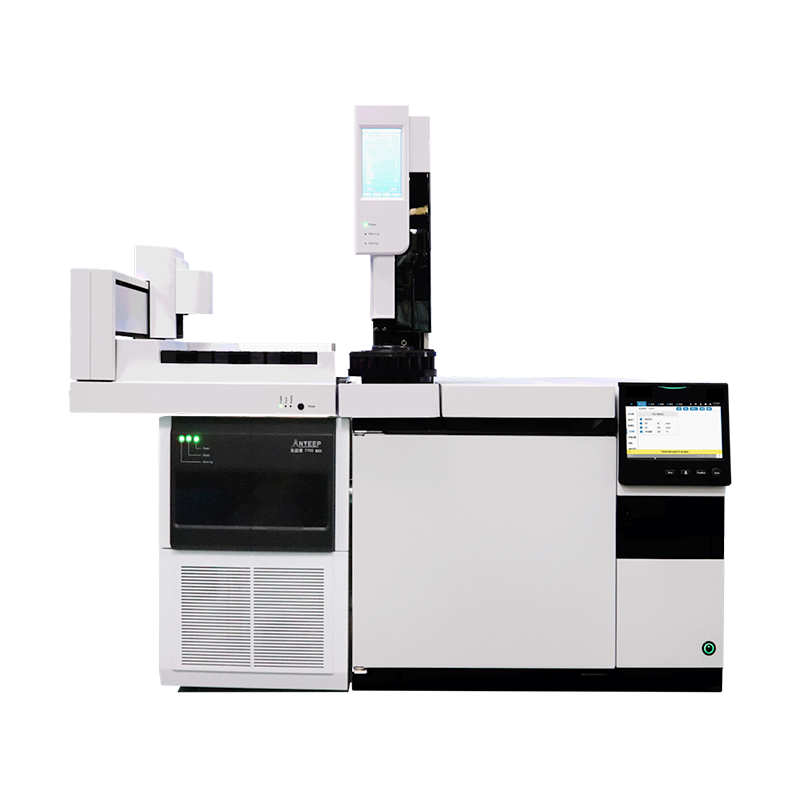
n-Alkanes in petroleum products are important chemical feedstocks. While many methods exist for determining n-alkane content, gas chromatography (GC) is the most common. This study employs gas chromatography-mass spectrometry (GC-MS) for the qualitative and quantitative analysis of n-alkanes.
Experimental Conditions
Chromatographic Parameters
Injection volume: 1µL; Injection port mode: splitless; Injection port temperature: 300℃; Carrier gas: Helium; Column flow rate:
1.0mL/min (Constant Current); Purge Flow: 50mL/min; Purge Time: 0.75min;
Column: HP-5MS 30m × 0.25mm × 0.25µm;
Column oven temperature program: 50°C (2.25min) 30°C/min 200°C (0 min) 15°C/min 300 (0 min) 25°C/min
320 (1 4 min).
Mass Spectrometry Parameters
Ion source: 300°C; Transfer line: 290°C; Solvent delay: 3.3min;
Scan Mode: Full Scan (SCAN); SCAN Mode
Experimental Results
Prepare n-alkane samples at a concentration of 1 ng/µL and a volume of 200pg/ µL. Inject 1 µL per run, perform 8 consecutive injections using Scan mode. Calculate the IDL for n-alkanes C9, C38, C39, and C40 using results from the 1 ng/µL sample; for all other n-alkanes, use results from the 200pg/ µL sample. Extract the quantifier ions for each n-alkane and calculate the relative standard deviation (RSD) of their peak areas to determine the IDL.
Prepare samples at a concentration of 50 ng/µL. Under the normal alkane test conditions with a split ratio of 50:1, compounds C7-C40 all produce peaks with good separation, and the solvent n-hexane does not interfere with the analysis. Due to the low sample concentration, splitless injection was used to evaluate linearity, repeatability, and limit of detection. However, the large volume of n-hexane interfered with n-heptane and n-octane; therefore, the linearity of C9-C40 was assessed. Solutions of C7-C40 normal alkanes were prepared at concentrations of 1, 2, 5, 8, and 10 ng/µL. These were tested sequentially under the standard normal alkane conditions. Each concentration point was measured in triplicate. A calibration curve was constructed using concentration as the ordinate and the peak area of the quantitation ions for each compound as the abscissa. The calibration equation (in ng/µL) and the linear correlation coefficient r are provided below.²Good linearity.
Prepare C7-C40 n-alkane samples at three concentrations: low (2 ng/µL), medium (5 ng/µL), and high (10 ng/µL). Inject the samples in low-to-high order 6 times each to evaluate within-day repeatability. The relative standard deviation is approximately 2%.