Determination of 8 N-nitrosamines in food using the Anyeep TQ9120 ultra-high-performance liquid chromatography-tandem mass spectrometry system
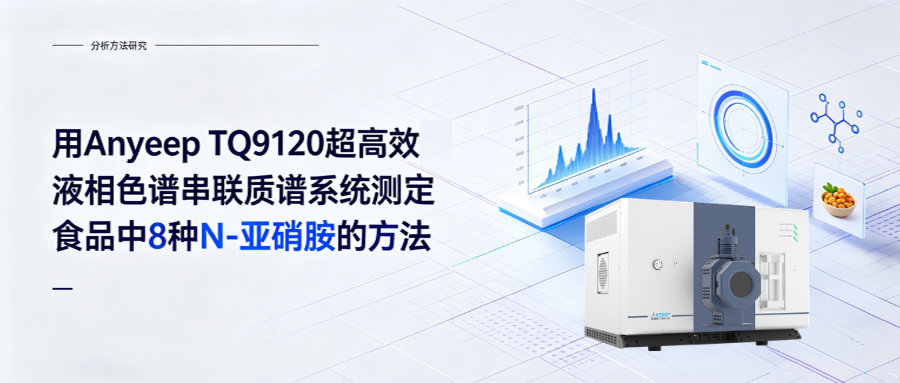
This study established a method for simultaneously detecting 8 N-nitrosamines in food using the Anyeep TQ9120 ultra-high-performance liquid chromatography-tandem mass spectrometry system from Anyeep. The method demonstrated excellent linearity, with detection and quantification limits meeting relevant standard requirements. Using this method and equipment enables the identification and quantification of antioxidants.
N-nitrosamines are a class of compounds containing a nitroso group, known for their potent carcinogenicity. They are widely found in food, tobacco products, and pharmaceuticals. Typical examples include N-nitrosodimethylamine (NDMA) and N-nitrosopyrrolidine (NPYR). As potent carcinogens, long-term low-dose exposure or single high-dose intake can trigger cancer development. Animal studies indicate that nitrosamines can cross the placenta and pass through breast milk to affect offspring, leading to tumor formation. Their carcinogenic mechanism typically involves metabolic activation: cytochrome P450 enzymes hydroxylate them in vivo to generate reactive intermediates such as diazonium salts or carbocations. These electrophiles react with DNA, causing mutations and carcinogenesis. Global regulatory bodies (FDA, EMA) require risk assessment, confirmatory testing, and limit controls for N-nitrosamines in pharmaceuticals to ensure daily intake remains below safety thresholds. Consequently, monitoring and detecting N-nitrosamine levels in food and pharmaceuticals is a key focus for quality supervision and inspection agencies. This method follows GB 5009.26-2023 and uses external standard quantification.
Instruments and Reagents
Anyeep TQ9120 Ultra-High Performance Liquid Chromatography-Tandem Mass Spectrometry System
Methanol (mass spectrometry grade, Thermo Fisher Scientific, USA)
Dichloromethane (MS grade, Thermo Fisher Scientific, USA)
Formic acid (mass spectrometry grade, Anpel Shanghai)
Liquid Chromatography Conditions
Mobile Phase A: 0.1% formic acid in water
Mobile Phase B: Methanol
Column: Phenomenex Kinetex F5, 100 Å, 2.6 µm, 3×100 mm
Column Temperature: 40 ℃
Flow Rate: 0.8 mL/min
Injection volume: 10 μL
Mass Spectrometry Conditions
Ion source: Atmospheric Pressure Chemical Ionization (APCI+)
Source Temperature: 400 ℃
Spray Voltage: 5000 V
Air Curtain Air: 20 psi
Mist: 90 psi
Crash Air: 8
Scan Mode: MRM
Sample Processing
Standard Curve PreparationDissolve the standard in dichloromethane to prepare a stock solution. Dilute the stock solution with purified water to the required concentration.
Sample PreparationPerform the operation in accordance with "Section 5.1 Sample Pretreatment" of GB 5009.26-2023 National Food Safety Standard: Determination of N-nitroso compounds in food.
Summary
This study establishes an analytical method for detecting N-nitrosamines in food using the Anyeep TQ9120 ultra-high-performance liquid chromatography-tandem mass spectrometry system. The results demonstrate that this method offers excellent sensitivity, stability, and linear range, making it suitable for quantifying N-nitrosamine residues in food samples.